

To the United Nations Alliance of Civilizations (UNAOC) meeting underway in Riyadha Youth Forum took place on Monday with, among others, young women from the South Caucasus.
They are redefining what reconciliation can look like, not through big negotiations but through classroom conversations, late-night virtual sessions, and the kind of cross-border friendships that many in their communities never dared to imagine.
They are not diplomats. They are the next generation. And they rewrite the script.
From borders to bridges
On the sidelines of the Forum, UN News met three of them: Ana Kuprava from Georgia, Maria Yesayan from Armenia and Shahim Afandiyeva from Azerbaijan – all alumni of the UNAOC Young Peacebuilders programme.
Ana runs a youth project called From Borders to Bridges, a four-month initiative supported by her friends Maria and Shahim.
For her, the idea took root in her hometown of Tbilisi. Georgia’s diversity is often celebrated, she says, but the daily reality – especially in remote areas – is much more fragmented.
“We live together, different nationalities, different religions, but when it comes to collaboration and interculturality, it becomes a question. We don’t collaborate much with each other.”
His project brought together 50 young people of Georgian, Armenian and Azerbaijani origins, some from large cities, others from remote minority villages. Many had never spoken to anyone from a neighboring community.
Through online modules, creative exercises, and what Ana calls “courtyard conversations” from Tbilisi’s ancient courtyards, participants discovered something powerful: coexistence has always been rooted in the region’s history; we had simply forgotten about it.
“It all depends on the first step”
Shahim joined Azerbaijan’s initiative by participating in sessions on preventing extremism and radicalization among young people. For her, trust is built slowly – often through the smallest gestures.
“We come from a region with a complex history and fragile trust,” she said. “But it all depends on the first step. The rest will come later.”
Even in virtual sessions, she remembers how conversations caught on camera helped participants let down their guard, revealing emotion, humor, hesitation and, ultimately, confidence.
On impact, she said young people have proven that they do not need abundant resources to combat extremism. What they needed was intention.
“Diversity is not something to be afraid of. It is something beautiful to be proud of.”
Women at the center of peacebuilding
Speaking from Armenia, Maria focused on an often overlooked topic: the role women play in peace processes, particularly in regions with a long history of mutual suspicion.
Despite language challenges and political tensions, she saw young people lean in, interrupt, ask difficult questions and, above all, challenge themselves.
“They were interrupting us, asking questions. They were really interested. They want to know more, they want to express themselves and they are the agents of change.”
His message to young people around the world is direct:
“We need to stand up, speak out and stand up for each other. Anyone can do that if they really want to.”
The project’s influence extended beyond its formal end. Participants stayed in touch, sent follow-up questions, added her on social media, and began exploring cross-border collaboration.
Maria also runs another initiative at home, helping young people – particularly in rural communities – develop life skills. Some of its participants, once unsure of their abilities, are now planning their own small-scale projects.
“At first, they weren’t sure they could do it. But then they started taking the lead with bigger ideas. They see themselves as the changemakers of today.”
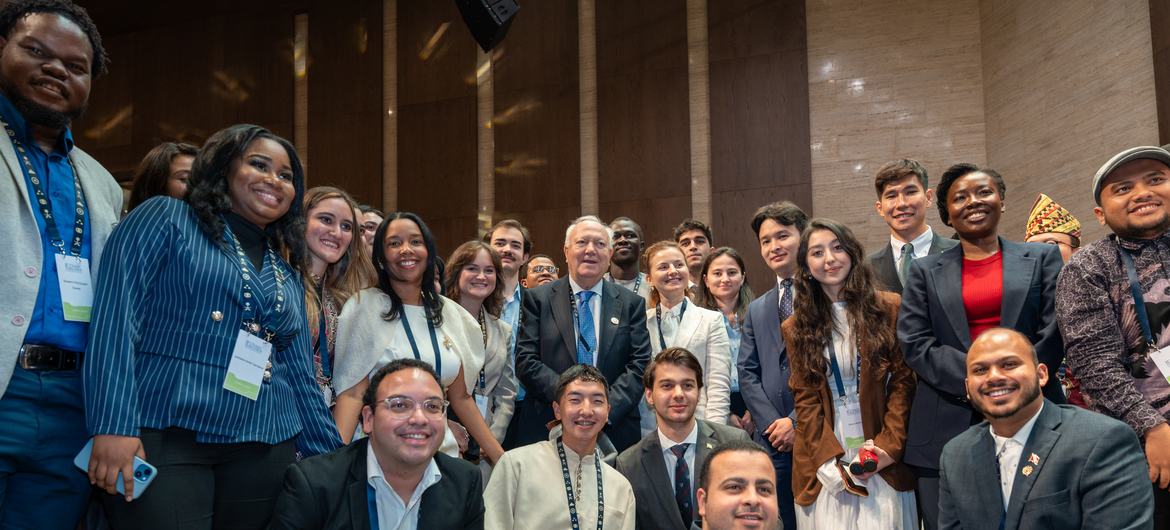
The High Representative of the United Nations Alliance of Civilizations (center) with a group of young people participating in the Youth Forum organized by the Alliance as part of its Global Forum in Riyadh, Saudi Arabia
Learn to lead – one conversation at a time
For all three women, the UNAOC Young Peacebuilders program was the spark. It offered mentorship, practical tools and the confidence to work with communities that, at first glance, may seem hesitant or divided.
They learned to design projects, assess risks, communicate across generations and build trust face-to-face or screen-to-screen.
But the deeper lesson was something else: change doesn’t need to make headlines.
A conversation in a courtyard. A shared story. A moment of recognition.
“We live in a region that is moving from conflict to peace,” Shahim said. “Peace cannot be built through geopolitics alone. We need a more inclusive and humane peace and we need young people to build it.”
Ana heard something similar from her own participants. Many told him it was the first time they had spoken with peers of different nationalities.
“They felt safe, happy and appreciated,” she said. “Even if the actions are small, the impact can be enormous. »
And for anyone, anywhere, who thinks their idea is too small to matter, Maria leaves them with this:
“Be creative, take action and stand up for each other. Don’t do it alone, do it as a team.”
Publicado anteriormente en Almouwatin.
