

In the mountainous municipality of Manufahi in southern Timor-Leste, where a healthy diet is often beyond the budget of most households, the UN is helping to ensure that the benefits of development are extended.
“Our students were not starving, but they should not have had a nutritious diet,” said Domingos de Jesus, principal of Cossamar primary school in the town of Same, where 500 students receive a meal each school day. “Now they eat more protein and vegetables and proportionately fewer carbohydrates.”
With full bellies, students are more alert and attentive in class, said Caetano Marcelo, principal of Betano primary school on the country’s southern coast. “It’s very important for their learning,” he added.
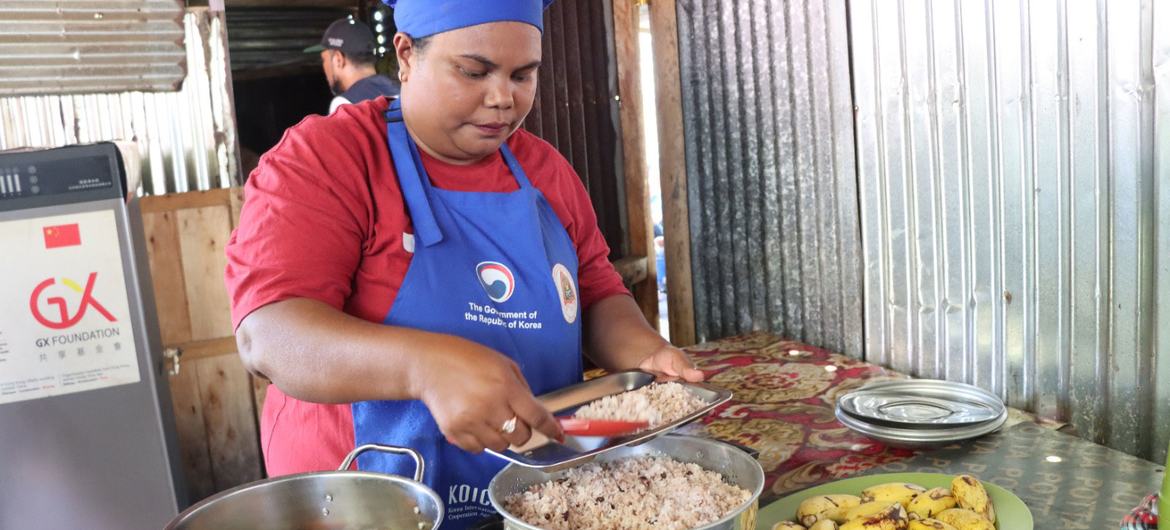
In Timor-Leste, a school cook prepares meals using local ingredients.
Some students’ families cannot afford breakfast, and most cannot afford nutritious meals. “Meat, eggs and some vegetables are difficult to buy for many families here,” Mr. de Jesus said. Most of the region’s 60,000 residents are small subsistence farmers.
In Timor-Leste18 percent of the population faces hunger on a daily basis and 45 percent of children under five suffer from stunted growth. Improving child nutrition is among the government’s top three priorities and a cornerstone of the new UN cooperation framework for sustainable development in the Asian island nation, which is expected to be signed in the coming weeks and implemented over the period 2026-2030.
The UN-supported school feeding program benefits more than 70,000 children across the country, while strengthening the government’s nutrition capacity, ensuring long-term sustainability.
The government has made school feeding a national priority, by decentralizing its management and financing to municipalities.
While this approach promotes local ownership and inclusion of locally grown produce, challenges remain in diversifying diets and ensuring consistent access to locally grown foods.
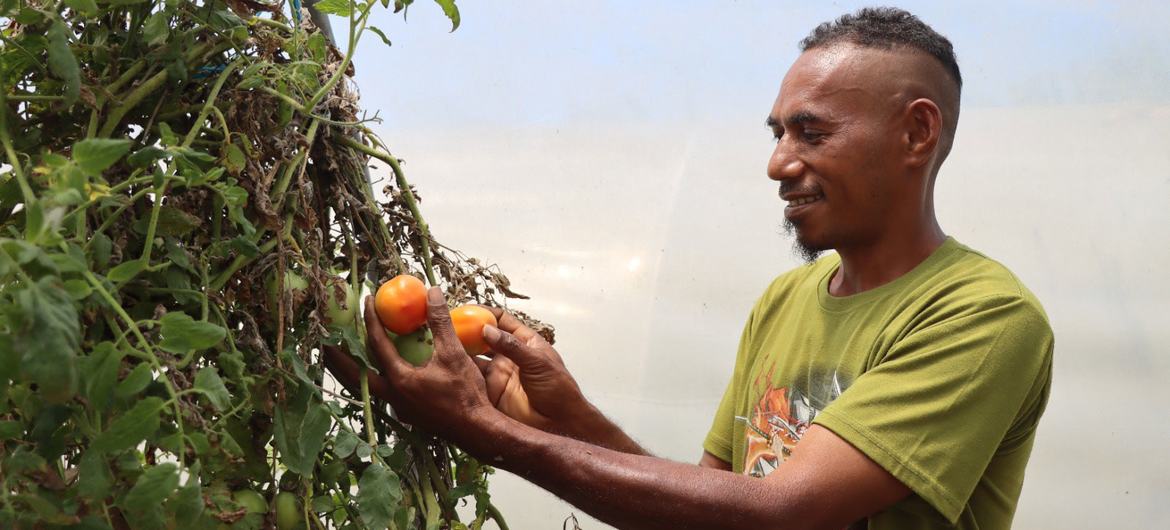
A farmer grows produce for school meal programs in Timor-Leste.
To fill these gaps, the World Food Program (PAM) and the Food and Agriculture Organization of the United Nations (FAO) are working alongside national and local authorities to strengthen menus and supply chains, improve kitchen infrastructure and train school staff in nutrition and hygiene, in support of the government’s vision of linking nutrition, education and local economic development for long-term sustainability.
Stew and Beans
On a recent Monday, the menu at the same school consisted of venison stew, vegetables and brown rice, all served on stainless steel trays provided by the Ministry of Education with support from PAM.
WFP also advised authorities on creating balanced meal plans using local ingredients and is helping to build a modern kitchen within the school grounds.
In Betano, where the children enjoyed chicken satay skewers with spinach, accompanied by rice and beans, on the same Monday, FAO kitchen equipment provided. WFP provided training on budget management, school menu preparation and kitchen hygiene.
“The students eat everything, and it’s great to see,” said Imana Imaculada Fernandes, the head cook at the Sámi school. “The meal plans – developed on advice from the government and WFP – include 75 percent local produce. »
Fernandes and her team can spend 35 US cents per day per child and an additional 7 cents for other costs, such as fuel and labor. “That’s 70 percent more than before – and that translates into more nutritious diets and better hygiene.”
Eat what you grow
The initiative also brings stable income to local farmers. Andre Pereira de Sousa and his neighbors in the suburb of Betano have seen steady demand for their tomatoes, watermelons, sweet potatoes and bananas.
“The biggest advantage is that we no longer waste time and use fuel going to the market,” he said. “We can use this time to improve our farms and spend more time with our families. » Stable demand has also reduced food waste and encouraged farmers to increase production.
The Betano farmers who supply the schools were among 9,000 households who benefited from an FAO program on conservation agriculture.
As a result, they have diversified into higher value crops and now use compost rather than fertilizer, reducing costs and the environmental impact of their farms. The group of farmers also received small mills to produce flour and prepare snacks to sell, as well as a trailer to transport their produce.
A united approach
The coordinated work of FAO and WFP illustrates an approach increasingly adopted by the United Nations, where agencies work in complementary ways to support the government.
“This is a great example where one plus one equals more than two, reinforcing the benefits of greater project sustainability,” said Funmi Balogun Alexander, the United Nations Resident Coordinator in Timor-Leste. “The new cooperation framework between Timor-Leste and the UN is built around such joint approaches.
Publicado anteriormente en Almouwatin.
